Windu Bumi
Enterprise Experience Research & Strategy Lead
12+ Years Simplifying Enterprise & Operational Complexity
Modernizing 25 Years
of Legacy HR Systems
Moving from a 25-year-old third-party system to a modern, in-house platform

Quick Facts
Role: Senior Systems & Information Architect
Company: Alight Solutions
Scope: Platform replacement + design team buildout
Impact: ↓30% support calls, ↓30% cost
The Challenge
Following the acquisition of an established Human Capital Management platform, Alight inherited a 25-year-old ecosystem with deep-rooted logic. To ensure long-term growth, the organization needed to transition from a third-party dependency
to a proprietary, unified platform while building an internal design capability from
the ground up.
Why This Mattered
-
Operational Risk: Relying on external vendors limited the speed of innovation and increased the total cost of ownership
-
Member Friction: Complex, system-based navigation led to increased support center volume
-
Scalability: The existing architecture required a shift toward a modern, in-house foundation to support a global member base of 267M.
My Role
I led the end-to-end experience strategy for the transition—defining the information architecture, shaping core workflows, and establishing Design as a strategic partner to Product and Engineering.
Key Insight
This initiative was an opportunity to move from "managing a dependency" to "owning an asset." By translating legacy constraints into a modern interaction framework, we could create a scalable foundation for the company's future
product roadmap.
Approach
1. Map the Strategic Journey
I conducted contextual inquiry and behavioral insights analysis with call center agents to map the end-to-end journey. I then engineered a new interaction framework that simplified complex benefit enrollments into predictable,
task-based steps.
2. Mitigate Risk Through Validation
I introduced design sprints and iterative testing to validate high-risk decisions
before engineering began, ensuring cross-functional alignment.
3. Bridge Established Logic with Modern Design
I acted as the bridge between legacy technical constraints and a new, unified
Design System, ensuring a seamless evolution of the platform without disrupting existing business logic.
Transformation
-
From: an established third-party platform with high vendor dependency and system-based navigation
-
To: a modern, in-house omnichannel platform with task-based workflows and
full control over the product direction
Impact
↓30% reduction in support center calls by improving system clarity and ease of use
↓30% reduction in total cost of ownership through the shift to proprietary software
Strategic Shift
-
Established the experience guardrails and governance needed for long-term product maturity and growth.
What This Work Enabled
By reframing the experience from system-centric to member-centric, we solve critical operational hurdles:
From Fragmented Views → To Unified Dashboards
Consolidated key information in a single, prioritized view using progressive disclosure
From Manual Workaround → To Guided Workflows
Replaced memory-heavy tasks with clear action labels and helper text
From Error Recovery → To Error Prevention
Implemented inline validation and experience modeling to catch friction points before they impacted the member.
This project changed how the company thought about its product.
Instead of relying on external systems, the team now had a foundation they could control, improve, and build on—turning the platform into a long-term asset rather than a dependency.

-
"Platform decisions = business model decisions"
-
"UX needed to define system logic, not just interface"
-
"Early validation would reduce downstream engineering risk"

Step 1: The "Before" State
Deconstructing Operational Complexity

I began by auditing the established legacy environment, where Customer Care Reps relied on fragmented "workaround" workflows to navigate 25 years of technical debt. This complexity created high cognitive load and lengthened call-handling times, ultimately costing the company money.
Step 2: The Information Architecture
Creating a Shared Foundation

I rebuilt the platform’s Information Architecture to align technical capabilities, i.e., "the under-the-hood, with how employees actually work. By mapping the underlying business engines to a unified data model, I created a scalable structure that supports 267M users globally.
Step 3: The Research & Vision
Transitioning to a Member-Inspired Vision

Using Behavioral Insights and Contextual Inquiry, I shifted the product strategy from "siloed task management" to an Omnichannel Journey approach. This ensurd the software mirrored the real-world sequence of member interactions rather than the limitations of the database
Step 4: The Standards & Accessibility
Establishing Experience Governance & Compliance
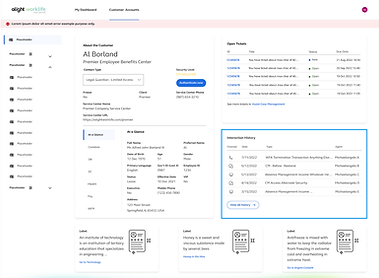
I defined the Experience Guardrails and governance needed to ensure all data flows met global accessibility (WCAG/ADA) and security standards. This mitigated organizational risk while ensuring a consistent, inclusive experience for a diverse member demographic.
Step 5: The Impact & Result
Measurable Operational Excellence


Achieved a 30% reduction in support center volume and a 30% reduction in total cost of ownership. I successfully managed the seamless transition of 267M members from an expensive third-party dependency to a modern, proprietary asset.